Residential artificial grass in Miami is quoted as a set of line items, not as a single square-foot number. Published Miami and South Florida bands put a complete professional installation at 9 to 15 per square foot, with most jobs landing between 11 and 15 per square foot. Material alone runs 2 to 5 per square foot for basic residential grass and 5 to 7 for premium pet-grade or high-face-weight grass, and labour is published at 8 to 12 per square foot. Removing the old lawn and hauling the debris adds 1 to 3 per square foot, and excavation with a compacted open-graded aggregate base adds another 1 to 3. What separates two quotes at the same headline price is how much of that base and drainage work is actually inside it.
What a residential installation actually involves
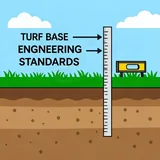
Four phases decide the result. First, the old surface comes out: lawn, roots, sprinkler heads, edging and any debris goes off site. Second comes the sub-base, where the yard is graded away from the house, a woven or non-woven geotextile separator goes down, and an open-graded aggregate is placed and compacted in lifts. Third is the grass itself: rolls are laid, cut to the edge, seamed with adhesive and seam tape, nailed or pinned at the perimeter, and brushed up. Fourth is infill, brushed into the pile to weight the surface and hold the fibres upright.
The base is where the money hides. A quote that names the aggregate, the compacted depth and the compaction check is a real quote. A quote that says "prepare the ground" is a price for grass on dirt.
Why drainage decides a Miami yard
The wet season runs roughly May to October and delivers short, heavy afternoon rain (https://www.weather.gov/mfl/, HTTP 200). Most of Miami-Dade sits on oolitic limestone under a thin layer of sandy fill, and the USDA-NRCS Krome series mapped across the county is a very gravelly loam that drains very fast (https://soilseries.sc.egov.usda.gov/OSD_Docs/K/Krome.html, HTTP 200). Fast drainage in undisturbed rock is not the same as fast drainage through a compacted construction pad. Once a crew grades and compacts a yard, water that used to disappear can sit. An open-graded base and a positive outlet, slope to a swale, a channel drain or a tie-in to the lot drainage, are what keep a Miami lawn from ponding against the house in July.
What the price is made of
- Material, 2 to 5 per square foot for basic residential grass and 5 to 7 for premium pet-grade or high-face-weight grass.
- Labour, published at 8 to 12 per square foot across South Florida installers.
- Removal and hauling, 1 to 3 per square foot when an old lawn, roots and edging leave the site.
- Excavation and compacted base, 1 to 3 per square foot depending on depth and on how much rock the crew meets.
- Infill and edge restraint, usually inside the labour line but worth naming in the contract.
A typical 500-square-foot Miami backyard lands between 4,500 and 7,500 installed. Small areas cost more per square foot because the mobilisation and the base work do not shrink with the lawn.
Heat, salt and ultraviolet load
On the EPA UV Index scale everything at 8 and above is very high to extreme, and Miami sits in that band for much of the year (https://www.epa.gov/sunsafety/uv-index-scale-0, HTTP 200). That is why the fibre choice matters more here than in a temperate market: a UV-stabilised polyethylene face with a published fade warranty holds colour, and a cheap unstabilised product greys out early. Salt air off Biscayne Bay adds a second attack on the backing and on cheap infill. Surface heat is the third: a full-sun synthetic surface runs well above air temperature on a hot afternoon, so lighter infill, some shade from planting and a quick hose-down before use are practical mitigations.
Writing a quote you can compare
Ask every installer for the same five lines: square footage measured on site, excavation depth, aggregate type and compacted depth, what happens to the old lawn and sprinklers, and where the water leaves the yard. Then ask for the perimeter and seam detail, because wind in the hurricane season works the edges before it works anything else. Two quotes that differ by a dollar a square foot usually differ by an inch of base and a drainage outlet. The cheaper one is cheaper because the part you cannot see was cut.
Frequently asked questions
What does residential artificial grass cost in Miami?
Published Miami bands are 9 to 15 per square foot for a complete installation, and most jobs land between 11 and 15 per square foot. Material alone is 2 to 5 per square foot for basic residential grass and 5 to 7 for premium grass, labour is published at 8 to 12 per square foot, and removal plus base work each add 1 to 3 per square foot.
How long does a residential installation take?
One to three weeks for a normal Miami-Dade yard. Rolling out, seaming and infilling is the shortest phase. Excavation, base, grading and compaction take the days, and wet-season afternoons can add rain days.
Do I need a permit for artificial grass in Miami?
A lawn replacement is normally a landscape change rather than a permitted building project. A new fence, wall, deck, patio roof, drainage structure or a grading change can require a permit, and a property in a special flood hazard area faces floodplain review. Every dig also needs a Sunshine 811 notice two full business days ahead.
Will artificial grass survive a Miami summer?
The fibre will, if it is UV-stabilised and properly backed. What fails in this market is the base: a yard laid over compacted fill with no outlet ponds in the wet season, and standing water then shows up as wrinkles, smell and seams that lift. Build the base for water and the surface lasts.
Related
Sources
- InstallArtificial - artificial grass prices in Miami
- Monster Grass South Florida - cost to install turf in Miami
- Synthetic Grass Warehouse Florida - Miami artificial grass cost page
- National Weather Service Miami-South Florida - wet season and hurricane season
- USDA-NRCS Krome series - the soil mapped across Miami-Dade
- Florida Statutes s. 373.185 - Florida-friendly landscaping and association rules
- Sunshine 811 - Florida one-call notice before digging